

National Hunt vs Flat Calendar: Seasonal Shifts in UK Racing Markets
A friend of mine once asked me, somewhere around the third drink at a wedding, why I had been talking about racing for forty minutes without ever mentioning Royal Ascot. He had assumed all of British racing was Royal Ascot in extension. I told him that what he had just watched on a windswept Saturday afternoon was a chase at Sandown, that the field had jumped sixteen fences, that several of the horses would not run again until the spring, and that the betting market for the race had behaved nothing like a Royal Ascot Group race. It was the first time he understood that British racing is not one sport. It is two: National Hunt and flat. They share infrastructure, governance and a Levy, but the calendars, the language and the betting markets are different enough that learning one does not automatically teach you the other.
This article is the field guide I wish I had been handed in my early racing days. It is not a glossary of every term, but a tour of the structural differences – the seasons, the race types, the ratings, the market behaviour – that explain why each-way places vary, why ante-post markets behave differently between codes, and why a winter Saturday Lucky 15 looks unlike a summer one.
Regardless of the code, evaluating the official going stick readings and turf conditions is vital for accurate form analysis.
Two Seasons, Two Centres of Gravity
The flat season in Britain runs roughly from late March to early November on turf, with all-weather racing covering the rest. The signature meetings are the five-day Royal Ascot in June, Glorious Goodwood in late July, the York Ebor festival in August, and the Doncaster St Leger meeting in September. The classics – the 2,000 Guineas, the 1,000 Guineas, the Oaks, the Derby, the St Leger – frame the flat year. The flat is breeding-led: most horses run as three-year-olds at their physical and commercial peak, then retire to stud.
The National Hunt season runs in counterpoint, peaking in the depths of winter. It opens slowly in October, builds through December’s King George at Kempton and the Welsh National at Chepstow, accelerates through the Christmas card, then runs hot from January’s Cheltenham trials through to the Cheltenham Festival in March and the Aintree Grand National in April. By the time the flat season is in full cry at Royal Ascot, the jumps is essentially asleep until the summer evening cards begin again in October.
The jumps population is older and runs deeper. In Q1 2025 there were 307 jumps horses rated 135 or higher on the BHA scale, against 288 the previous year – a small but meaningful increase in the depth of the championship class. Flat ratings work to a different scale, with the top class concentrated in younger horses; jumps horses tend to peak between six and ten and frequently win Pattern races into their second decade. The vocabulary follows the population: a flat punter talks about juveniles, three-year-olds, classic generations; a jumps punter talks about novice seasons, second-season chasers, veteran handicappers. The phrase second-season chaser carries actual market weight in the National Hunt code; it has no flat equivalent.
The Jumps Race Types in Plain English
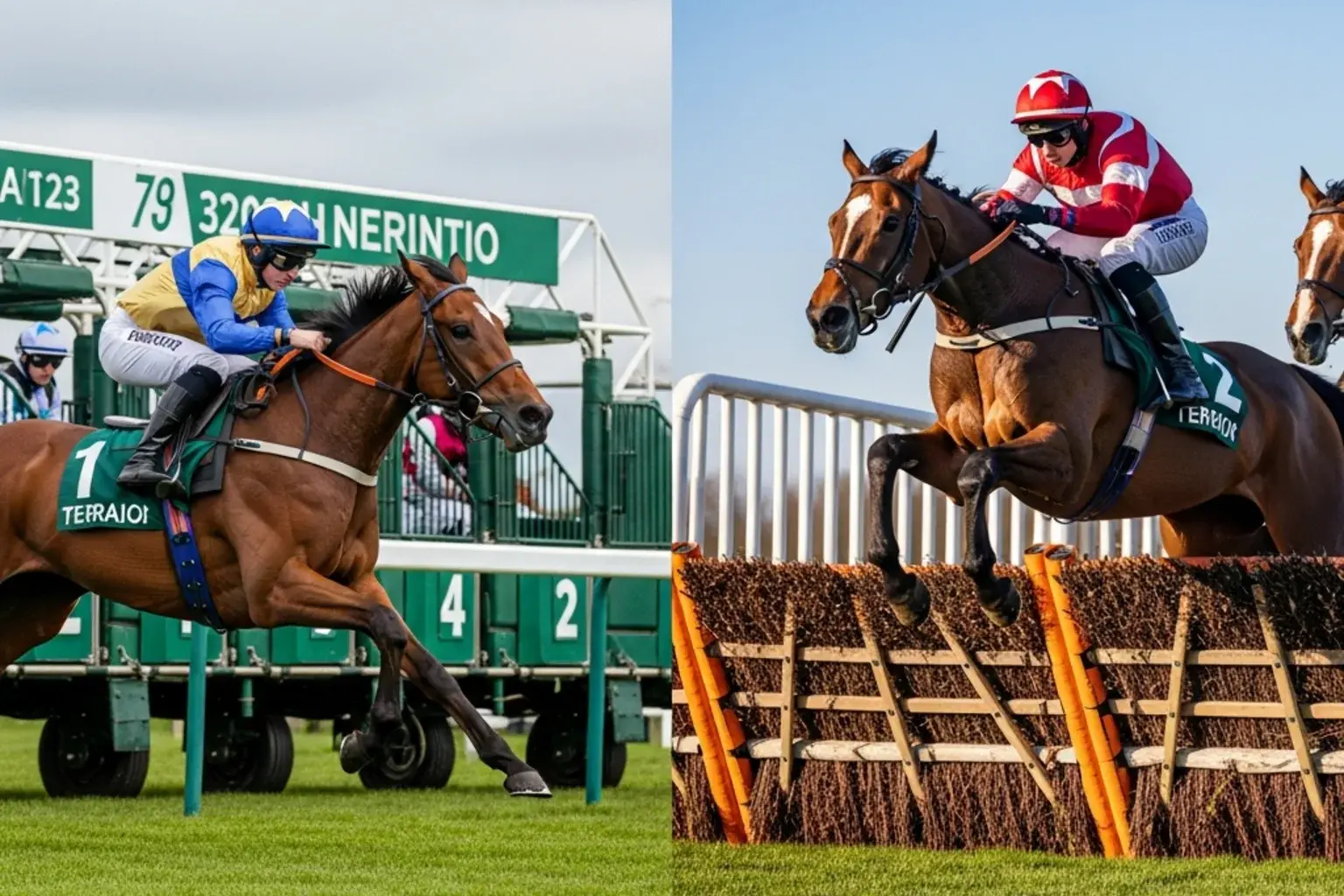
There are three jumps race categories that every punter needs to recognise. A hurdle race is run over hurdles – flexible obstacles three feet six inches high – over trips from two miles to three-and-a-quarter. Hurdles are the entry-level jumps category: horses begin as Novice Hurdlers in their first season over obstacles, then progress to either staying hurdles or chasing. A chase is run over fences – fixed, stiffer obstacles of varying height with ditches and water on the championship courses – over trips from two miles to four-and-a-quarter. The Gold Cup is a chase. The Grand National is a chase. Chasing is the senior jumps discipline.
A bumper, or National Hunt Flat race, is run on the flat without obstacles, on jumps cards, for horses bred for jumps but not yet introduced to obstacles. Bumpers exist to give young jumps-bred horses race experience before they meet hurdles. The race type is flagged as NHF on the racecard, and the form shows no jumping figures – only finishing positions on the flat.
One critical thing to grasp: a horse can run in all three types, often within a single season. A novice chaser is by definition a horse that ran over hurdles last year and over fences this year. The form line you read on the racecard might show a hurdles run from spring, a bumper from autumn before that, and a chase debut last month. Reading the form requires understanding which obstacles each previous run involved. The codes interact, and the betting markets price the transitions: a horse that was talented over hurdles is not guaranteed to take to chasing, and the market discounts the unknown heavily on the chase debut.
The Flat Race Types and What Each Signals
Flat racing has its own three-way structure, though the boundaries run differently. Pattern races are the top tier: Group 1, Group 2, Group 3 and Listed races, classified by the European Pattern Committee, with prize money and prestige scaling up the hierarchy. A Group 1 win confers black type in the breeding catalogue and adds millions to a horse’s stud value. The five English Classics – 2,000 Guineas, 1,000 Guineas, Oaks, Derby, St Leger – are all Group 1.
Handicap races are races in which each horse carries weight calibrated to its official BHA rating, with the intention of giving every runner an equal theoretical chance. The handicapper publishes a weekly ratings list and updates it after every race. The handicap mark is the single most important number on a flat horse’s racecard, and the maths is unforgiving: a one-point rating rise equals one pound of additional weight, and a pound at the back end of a sprint trip on softer ground is genuinely meaningful. Most flat handicap betting markets price horses primarily on whether they look ahead of, behind or in line with their mark.
Maiden races are for horses that have not yet won. They are usually limited to two-year-olds or three-year-olds early in the season, and they exist to give unraced horses the chance to break their duck against similar company. The market language around maidens – first-time-on-the-track, schooled in private, bred to be smart – is one of the most distinctive corners of flat punting and is covered in how to read a British racecard form line.
Explore detailed breakdowns of both codes on our premier UK racing betting portal.
Why the Betting Behaves Differently Between the Codes
The clearest difference in punter behaviour between flat and jumps shows up in the each-way market. National Hunt handicaps regularly pay five, six or even seven places at festival meetings; flat handicaps typically pay three or four. The reason is field size and dropout: jumps races lose runners to falls, pull-ups and unseats, and the bookmaker’s place-term liability is calibrated against the probability of any given runner finishing in the frame. Bookmakers offer the extra places at Cheltenham and Aintree as headline promotional terms in part because the jumps form line genuinely justifies it.
Ante-post behaviour is different too. Cheltenham and Aintree ante-post markets open early – sometimes a year before the race – and stay active for months, with serious volume turning over in the weeks before the festival. Flat ante-post is more concentrated: the classic markets open in autumn of the previous year and bookmakers traditionally tighten or close non-runner-no-bet concessions earlier. The market participants are different too; jumps ante-post tends to attract the form student, flat ante-post the breeding-and-pedigree obsessive.
And then there is the tax architecture sitting under all of it. Total British racing prize money rose by £4.7m to £153m in 2025, but grassroots fixture prize money fell by £3.6m – a clear sign that the top of the sport is holding while the lower rungs are squeezed. The BHA’s acting Chief Executive, Brant Dunshea, told SiGMA in August 2025 that increased taxes will undermine the offer across the board, that racing is vulnerable to these changes, and that any further tax rises will threaten jobs and derail horseracing. The tax point matters here because the codes are not equally exposed: flat racing’s commercial layer – sales, stud values, international prize money – provides a cushion that jumps does not have. Jumps depends much more heavily on Levy redistribution, gate receipts and a healthy handicap programme. When the Treasury rebalances betting duty, the jumps code feels it sooner.