
Turftrax Going Stick Metrics: Reading the UK Ground Condition Scale
You can read everything ever written about a horse, study the form, follow the trainer’s social media, eavesdrop on the parade ring – and still lose money because the ground rode softer than the official going suggested. Going is the single most underestimated variable in British racing. It changes the result more often than any other factor outside the price itself, and it is described in a vocabulary so specific to the British turf that international punters frequently get it wrong on their first festival.
I have stood next to a clerk of the course taking going readings on a January morning at Wetherby, and I have stood in a parade ring at Royal Ascot watching the same official chalk up Good to Firm at lunchtime. The exercise looks identical in both places. The vocabulary is identical. The implications for the betting are almost completely different. This article is the explanation I give to friends every March when they ask me, again, what Good to Soft actually means.
The Seven-Step Scale, From the Mud to the Bone
The British going scale runs from softest to firmest in seven defined steps: Heavy, Soft, Good to Soft, Good, Good to Firm, Firm, Hard. Each step has a definition the BHA codifies and the clerks apply consistently across the country’s 59 licensed racecourses. The scale is the same whether you are reading a winter card at Sedgefield or a summer card at Goodwood, even though those tracks rarely share the same description in the same week.
Heavy is mud you can stand in and feel the suction. Soft is grass that gives noticeably under foot but does not hold water on the surface. Good to Soft is the most common reading on a British turf course in spring and autumn – the grass holds its shape, the surface yields gently, jockeys describe it as honest ground. Good is the spring or autumn ideal, the going on which most championship races are run when the weather cooperates. Good to Firm is summer at a well-managed track – Newmarket in July, Goodwood in late July, Ascot in June. Firm is hard summer ground that punishes horses without watering. Hard is a reading the BHA discourages and most clerks try to water away before it ever appears on a board – the ground is dry enough to risk injury and most trainers will withdraw their horses rather than run on it.
One quirk worth knowing: the all-weather surface scale is entirely separate. Britain has five all-weather tracks – Chelmsford, Kempton, Lingfield, Southwell, Wolverhampton – plus Dundalk in Ireland, and they use surface-specific descriptions like Standard, Standard to Slow and Slow. The going stick is not used on all-weather tracks, and the seven-step turf scale does not apply. A horse that loves Heavy on turf will not necessarily handle Slow on Polytrack, and the form line tells you which surface the horse has run on as a separate flag from the going reading itself. Britain’s all-weather tracks and surfaces covers the synthetic side in detail.
The Going Stick Itself, and How a Reading Is Made
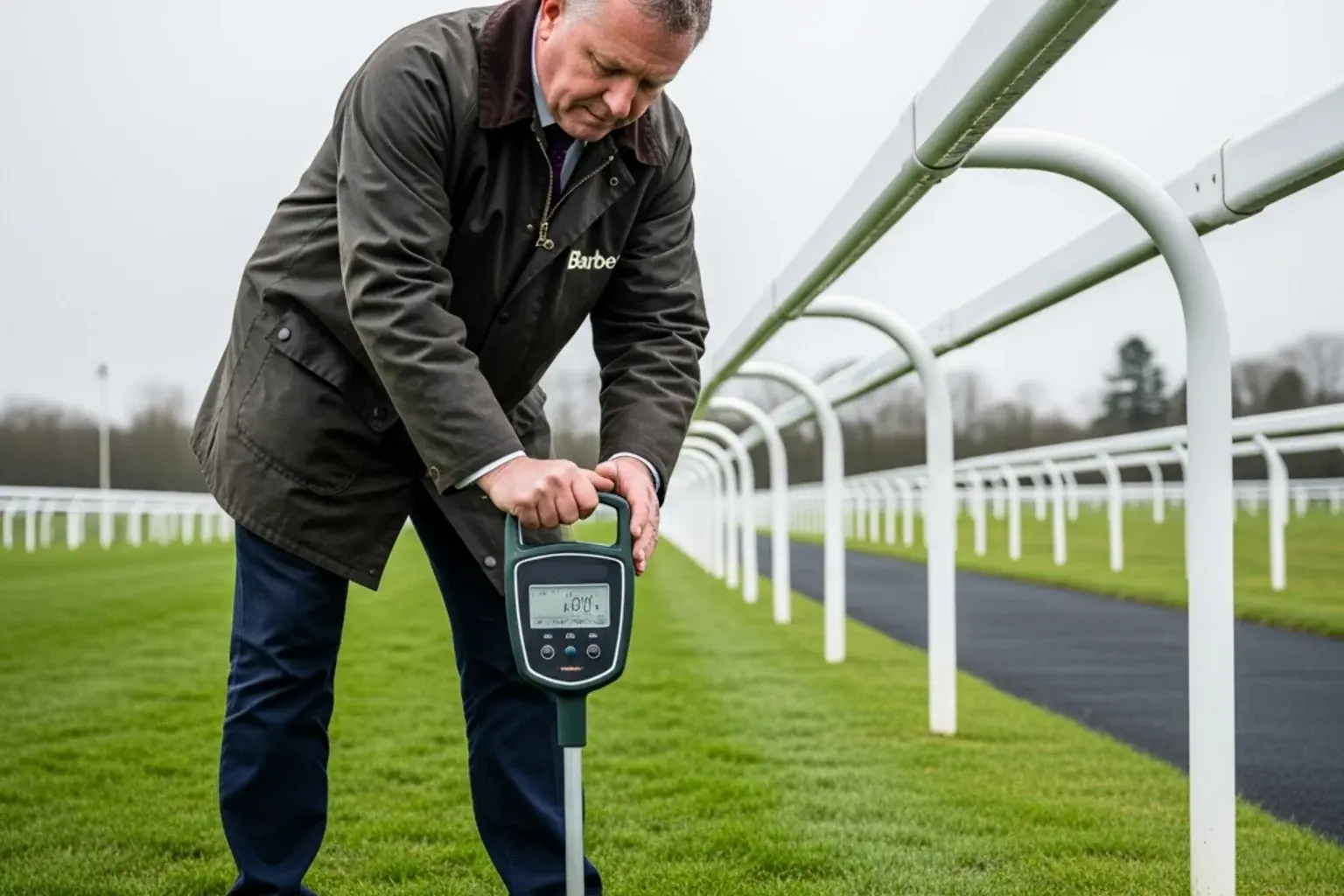
The Going Stick is a penetrometer – a tool that measures both the penetration and the shear strength of the turf. Manufactured by Turftrax, an English firm based in Newmarket, it has been the standard instrument on British racecourses since the mid-2000s. It looks unimpressive: a metal foot on a vertical shaft, a digital readout in the handle, a battery pack. The clerk of the course presses it into the turf at multiple points around the track, the readout averages the measurements, and the resulting Going Stick number sits alongside the verbal description on the board.
The numbers run from very low – around 4 or 5 on Heavy ground – to high values of 12 or more on genuinely Firm summer turf. Good to Soft typically reads between 6.5 and 8; Good is usually 8 to 9.5; Good to Firm above 9.5. The BHA publishes the reading on every official racecard as a complement to the verbal going, and the dual reporting is deliberate: the verbal description carries history and feel, the numerical reading provides a quantitative reference. Together, they give the punter two ways into the same question.
The mechanics matter because of variability. A single Going Stick reading is an average of multiple measurements at multiple points around the course. Some clerks measure six points; some measure twelve. The reading represents the entire track at the moment of measurement, not the specific lane the leading horse will take. On a long straight in dry weather, a horse that hugs the rail might be running on slightly faster ground than the centre of the track; on a watered course, the irrigated areas might read slower than the unwatered patches. The stick captures the average, the experienced jockey reads the actual ground, and the discrepancy between the two is one reason on-course information continues to carry weight in betting markets even in an era of universal data feeds.
British racing’s infrastructure scale gives the Going Stick its consistency. The country has 59 licensed racecourses, more than 500 training yards, and around 660 breeding operations – together delivering roughly £4.1 billion of direct and indirect economic value to the UK economy each year. That scale supports a fully professional going-measurement regime: every track measures, every track reports, every track applies the same instrument with the same calibration standards. Few sports anywhere in the world measure their playing surface as consistently.
Overnight Changes and Why Tomorrow’s Going Is Never Today’s
The going on a British racecourse can change overnight by two steps in either direction. A dry warm wind across the Cotswolds in March can turn Good to Soft into Good by morning. A heavy April shower at Newmarket can turn Good to Firm into Soft within four hours. Clerks of the course publish their reading by mid-morning on race day, but the reading reflects the ground at the moment of measurement, not the going under the hooves of the winner three races later.
This is why experienced punters do not commit to bets until the morning of the race itself, even on a forecast that looks settled. The going reading is the single most important update of the day on the racecard, and a serious horse trained for soft ground will be withdrawn rather than run on Good to Firm; a horse that needs a sound surface will be scratched rather than run on Heavy. Overnight withdrawals tied to going changes are not rare – they happen at most jumps meetings through the winter and at every major flat festival when the weather shifts late.
The clerk has tools to influence the ground within limits. Watering systems on most courses can soften Good to Firm towards Good in the days leading up to a meeting. Drainage and aeration work between meetings can prepare the course for expected weather. But the clerk cannot fundamentally alter the going against the weather – when March drops heavy rain on Cheltenham, the course will run softer than the schedule wanted, and the field will be smaller because of it. Going changes drive non-runners, non-runners drive Rule 4 deductions, and Rule 4 deductions reshape the maths on every fixed-odds bet that survives the morning.
The Going as a Betting Decision
Reading going as a punter is mostly about matching horse to ground. A staying chaser bred for stamina and trained on heavy gallops will typically win at a price on Soft or Heavy in March, while the same horse will run flat on Good to Firm in October. A flat sprinter with a low going stick preference – meaning the horse runs best on Firm – will be unbackable in summer and miserable in autumn. The form book carries this information in plain sight: every horse’s record shows its results across going categories, and a horse with three wins on Soft and zero on Good to Firm is telling you exactly where its money is.
The market prices most going preferences correctly most of the time, but the edges sit where the market is slow to react – particularly at midweek Core fixtures where liquidity is thin and prices reflect computer-generated tissue rather than live trader judgment. A horse with strong going-specific form running at a midweek meeting on its preferred ground often opens at a price that closes substantially shorter by the off, and the early-price punter who notices the going match can sometimes catch a horse two or three points longer than its closing show. The reverse applies in winter: a horse with summer-only form running at Sedgefield on Heavy is almost always overpriced for a reason – the market is telling you the trainer is not optimistic. Listening to the market on going is not difficult; it just requires reading the price as part of the going decision, not separate from it.