
All-Weather Track Surfaces: Polytrack, Tapeta and UK Synthetic Racing
Most people who watch British racing watch the turf. The Royal Ascots and Cheltenhams hold the cameras and the conversation, and the all-weather sits in the background – Tuesday nights, Friday floodlight cards, January afternoons at Wolverhampton in front of a small but committed crowd. Yet the all-weather absorbs a meaningful share of the betting calendar, and the surfaces themselves carry their own technical vocabulary that does not transfer from turf and does not transfer between synthetic types.
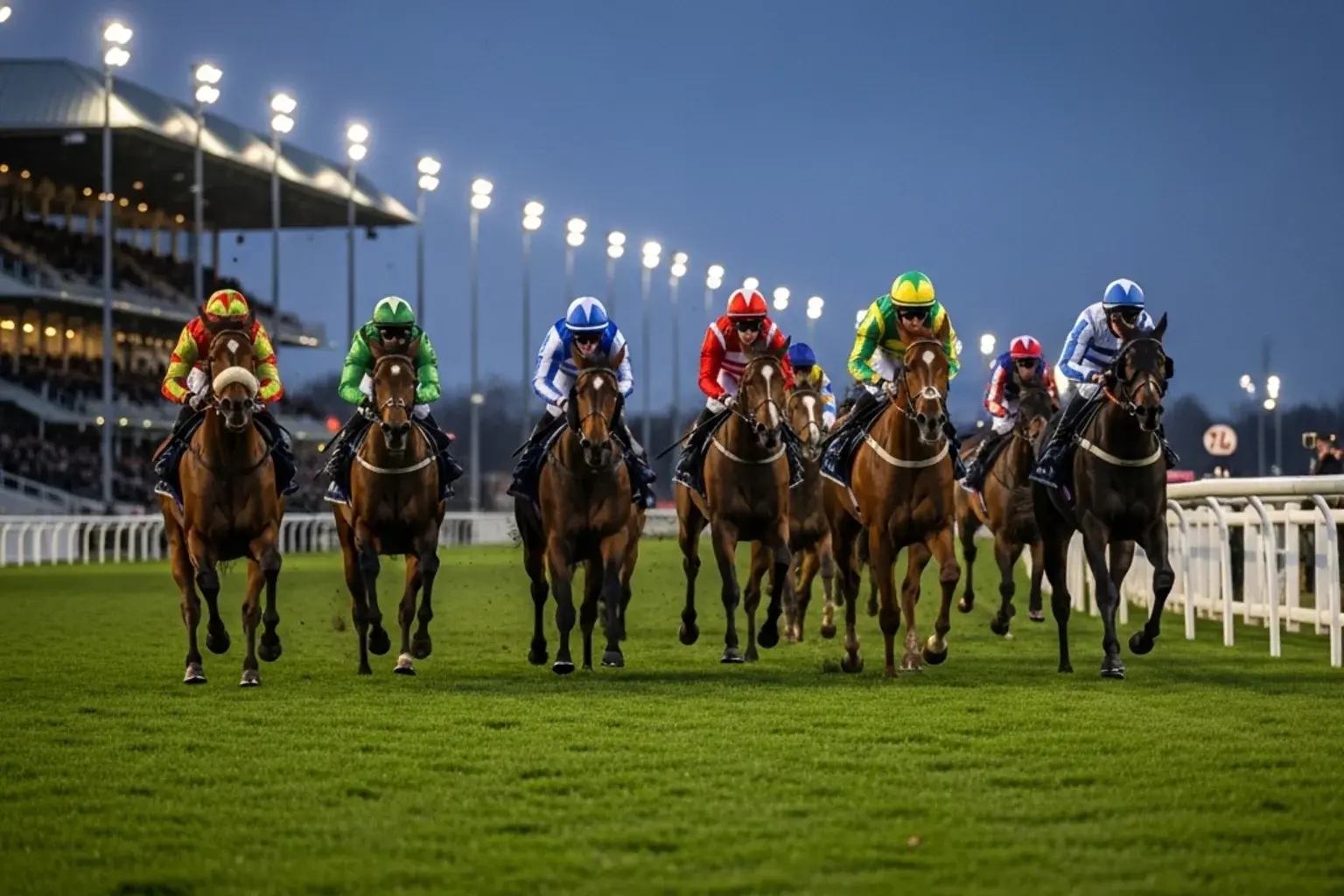
I have spent quite a few Saturday evenings at Wolverhampton over the years, partly because the racing is steady and partly because nobody else seems to want to write about it. The vocabulary is different – Polytrack, Tapeta, kickback, Standard going, Fibresand on the gallops – and the markets behave differently from turf. If you have ever stared at a Lingfield card on a wet Tuesday in February and felt the form book did not help, this article is for you.
Five UK Tracks, Plus Dundalk Across the Sea
Britain has five licensed all-weather racecourses on 2025-2026 calendars: Chelmsford City in Essex, Kempton Park in Surrey, Lingfield Park in Surrey, Southwell in Nottinghamshire, and Wolverhampton in the West Midlands. Ireland adds Dundalk, which sits on most British punters’ radar because British bookmakers price it the same as the home tracks and the form lines feed directly into UK ratings. That gives the British all-weather community six tracks to choose from in any given week, a small but functional circuit.
Each track has its own quirks. Chelmsford runs a left-handed mile-and-two course with Polytrack and a tight finish; Kempton runs right-handed Polytrack on the inner circuit while its outer is reserved for jumps in winter; Lingfield runs left-handed Polytrack with a famous downhill bend that suits front-runners; Southwell switched from Fibresand to Tapeta in 2022 and now races on a more European-style surface; Wolverhampton runs left-handed Tapeta on a tight figure-of-eight floodlit course that produces sharp, fast-finishing races. Dundalk runs Polytrack, similar in character to Lingfield, and its prize money attracts good fields for an Irish all-weather track.
The synthetic surfaces are not interchangeable. A horse that runs well at Lingfield on Polytrack will not necessarily handle Wolverhampton on Tapeta, even if both surfaces look superficially similar to the casual viewer. The form book treats them as separate surface flags, and the betting markets price them separately. Backing a Polytrack form horse at a Tapeta track is one of the classic recreational-punter mistakes – the data is sitting right there, and most newcomers skim over it.
Polytrack and Tapeta: What the Material Difference Actually Means
Polytrack is a synthetic surface manufactured by Martin Collins Enterprises, a British firm based in Berkshire. It is made of silica sand, synthetic fibres and small pieces of recycled rubber and PVC, all coated with a waxy binder that holds the mixture together and resists temperature change. The waxy coating is the headline feature: it allows the surface to remain consistent through frost, rain and heat. Polytrack is the surface at Chelmsford, Kempton, Lingfield and Dundalk, and it has been the dominant British all-weather surface since the early 2000s.
Tapeta is a competitor surface manufactured by a Maryland-based company founded by the British trainer Michael Dickinson. It uses sand, fibre and wax in slightly different proportions, with a lower wax content and a more aggressive top dressing that produces a faster, looser surface than Polytrack. Wolverhampton and Southwell currently run on Tapeta, and Newcastle’s straight all-weather mile uses a Tapeta installation as well, although Newcastle is more commonly classified as a flat course with all-weather supplementary use rather than a dedicated all-weather venue.
The practical riding difference is real. Polytrack tends to ride deeper and more even, suiting horses that stay well and grind out a finish. Tapeta tends to ride faster and bouncier, producing tighter race patterns and sometimes more pronounced kickback for horses running off the pace. Trainers know which of their horses prefer which surface, and the entry patterns reflect it: a yard with a Polytrack specialist will skip the Tapeta cards and target Lingfield and Chelmsford instead. The British all-weather calendar is calibrated around this preference structure, and the punter who pays attention catches edges that the form-line-only punter misses.
The All-Weather Calendar and the Good Friday Showpiece
All-weather racing runs year-round, but its identity is concentrated in the winter – November to March – when turf racing is constrained by frost and abandonments. The peak event is the All-Weather Championships, run on Easter Good Friday at Lingfield in 2026, with a programme of six championship races covering sprint, mile, middle-distance and staying categories. The day itself was designed to give the all-weather calendar a focal point – its own equivalent of Cheltenham or Glorious Goodwood – and it has succeeded to a meaningful degree, with prize money rising year on year and the championship-eligible horses earning their places through qualifying performances at the five UK tracks through the winter.
The qualifying system gives all-weather racing structure. To run in a championship final on Good Friday, a horse must have placed in a qualifying race in the category at one of the British all-weather venues during the season. The qualifier-and-final architecture matters because it creates a season-long narrative: the autumn races in November fill the entry list for the championship races in April. The betting markets price the qualifying status as part of the horse’s profile, and a championship-qualified horse running at a midweek meeting in February is reading subtly differently from a non-qualified horse in the same race.
The total turnover on British racing has been slipping for several years. Through the first nine months of 2025 the BHA’s Racing Report showed turnover down 4.2 per cent year on year and 12.8 per cent on 2023, with average turnover per race off 5.8 per cent year on year. The all-weather is not immune – its share of the total betting handle has held up better than core midweek turf, in part because winter all-weather competes against jumps for the same betting pound and tends to attract regular punters who study the surface form. The David Armstrong, Chief Executive of the Racecourse Association, said in January 2025 that, given the wider economic difficulties impacting households across the country and the increased amounts of on-demand domestic entertainment, the attendance figures give cause for optimism, with horseracing unique amongst major sports in attracting customers looking for elite sport and a fantastic social occasion. That framing applies as much to a floodlit Wolverhampton evening fixture as it does to Royal Ascot – different scale, same proposition.
How the Betting Reads on the Synthetic Surfaces
The all-weather betting market has its own personality. Prices tend to be sharper than midweek turf, partly because the form lines are cleaner – no going variability beyond the surface description, no abandonment risk, more consistent race scheduling. Trainers can place horses precisely, jockeys know exactly what they are riding on, and the form book is unusually reliable across multiple runs. That tightness reduces the recreational-punter edge available from turf-style going analysis, and it pushes the meaningful edges into surface preference, track configuration and trainer-yard specialisation.
One betting term that lives almost entirely on the all-weather is kickback – the sand and fibre that flies up off the leading horses’ hooves into the faces of the runners behind. Kickback affects different horses differently, and a horse with strong on-the-pace form on synthetics is often a horse that simply does not like running through it. Tapeta produces more kickback than Polytrack in most conditions, which is part of why pace-pressing horses tend to be priced shorter at Wolverhampton and Southwell than at Lingfield and Chelmsford.
Each-way places on all-weather typically run three or four, lower than the festival-time turf headlines. Bookmakers price the all-weather conservatively because the form is reliable enough that they do not need to chase volume with extra-place promotions. The market behaviour is more like a regulated commodity market than the carnival-style headline pricing of Aintree or Cheltenham, and that has its own appeal for the punter who likes the maths to work out cleanly. Britain’s 59 racecourses mapped by region gives the wider picture of how the all-weather sits within the country’s track infrastructure.