
Best Odds Guaranteed (BOG): Maximizing Returns Against Starting Price
The first time I tried to explain Starting Price to a friend who had wandered into Cheltenham off the back of a stag weekend, I made the mistake of starting with the maths. His face did what faces do when someone uses the phrase “weighted median of representative on-course samples” before lunch. So let me try a better opening. Starting Price is the price your bookmaker uses to settle a bet when the gates open and the horse is off — and it is not, in any meaningful sense, the price any single bookmaker chose. It is an industrial benchmark, calculated from a sample of the on-course bookmakers shouting in the ring at the moment the race begins, and then signed off by an oddly old-fashioned body called the SP Regulatory Commission.
Best Odds Guaranteed is the other half of this story, and a more commercial one. It is a promise — not a regulation, not a rule, a commercial promise — that if you take a price in the morning and the SP comes back longer, your bookmaker will pay you at the bigger of the two. That promise used to be the assumed default in British retail. In 2026 it is no longer. The ground beneath BOG has shifted, and the way it has shifted tells you something about where the industry is, financially and politically.
Twelve years of writing about this market have taught me that punters who lose money to SP and BOG mostly lose it because they do not understand the timeline behind a price. They see “5/1 SP” on the screen and assume that number arrived from somewhere clean. It did not. By the end of this piece you will understand exactly where it came from, who measured it, and why your account might be quietly excluded from the BOG promise that the website is still advertising in the header.
What Starting Price Actually Measures
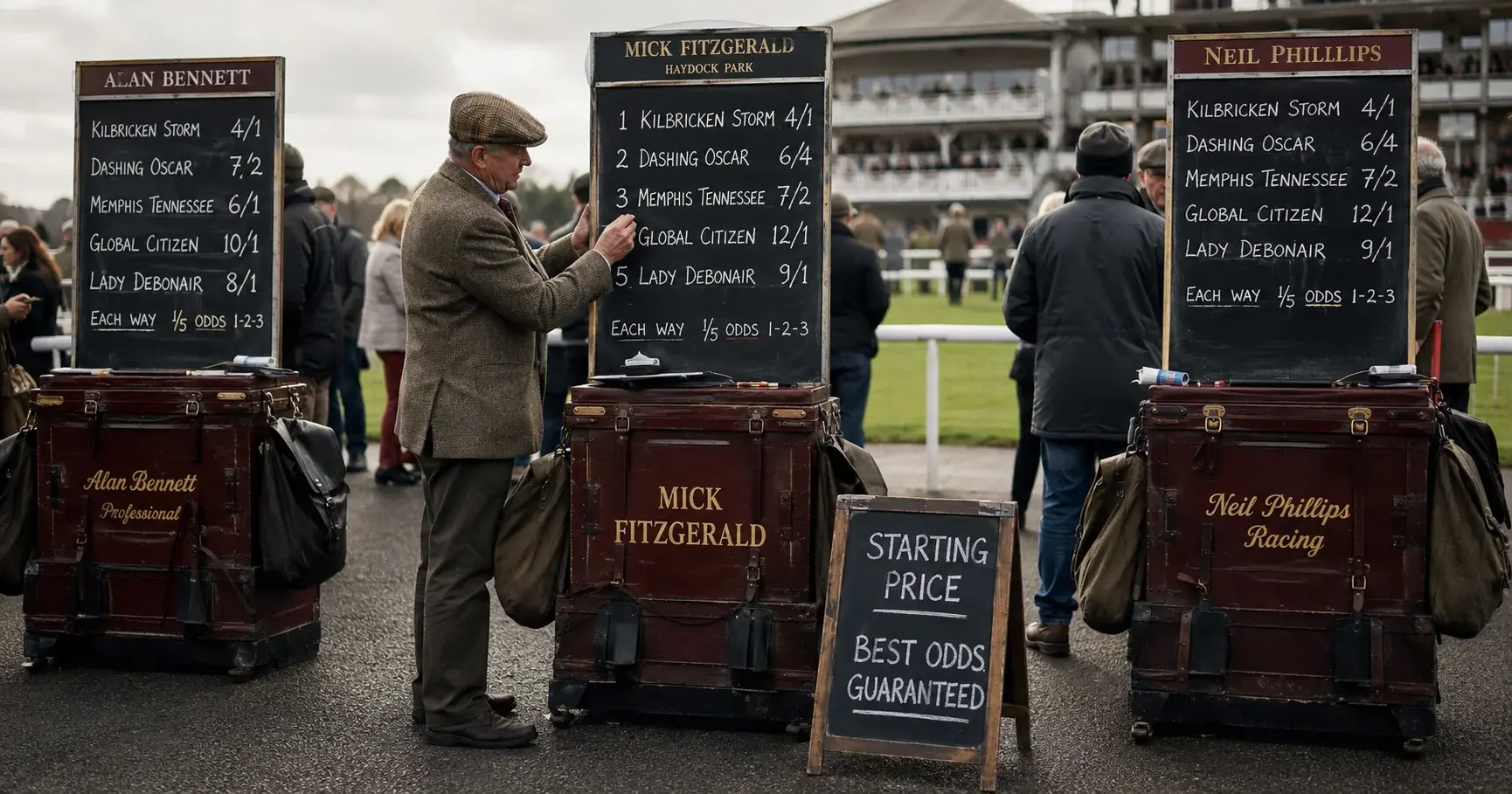
Picture the betting ring at Doncaster on a Saturday afternoon. Roughly forty firms, boards chalked and rechalked, runners moving between rows, money changing hands at a tempo that has not really changed since the 1930s. The Starting Price is the photograph taken of that ring at the instant the horses come under starter’s orders. Not before. Not the average of the last fifteen minutes. The instant.
That photograph matters because it settles the great majority of off-course bets in the country. Even with online turnover on remote betting on horse racing running at roughly £767 million in the year to March 2025, the SP is still the price the average punter ends up with — partly through habit, partly through bet-slip defaults, partly because it remains the universal fallback when no better price was taken.
What has changed, and what is worth understanding, is how thin that ring has become. Average turnover per race in British racing was down eight per cent in 2024/25 against the previous year, and down nineteen per cent on 2021/22. Less money in the ring means a sample drawn from fewer firms shouting at slightly less aggressive prices. The SP-derivation methodology has had to adapt to that thinning, and the 2018 reforms to the sampling rules were the most consequential change in three decades.
Betting Ring Sampling
The mechanics are simpler than the jargon suggests. A team of sample-takers — formerly Press Association reporters, now operating under RaceTech’s industry contract — walks the ring during the run-up to the off. They are watching boards, not lips. The job is to record the price on offer at each sampled firm at the moment of the off, and to record only firms that are genuinely doing business at that price. A board displaying 6/1 with a man standing behind it taking no money is not a sample. A board displaying 11/2 with three slips going across the table in a minute is.
Before 2018 the sample size could collapse to two firms on quiet midweek cards. That was the structural weakness that the reform addressed. The current rules require a minimum of three independent firms in the sample for a price to be returned, with most major meetings drawing samples from six to a dozen. On Cheltenham Tuesday or Derby Day the sampled firms can run into the high teens, simply because more bookmakers are physically there and active.
The phrase “independent firms” matters more than it looks. Two boards owned by the same parent count once. The aim is not to inflate the sample with mirror prices but to measure the genuine range of opinion in the ring.
Weighted Medians vs Modal
Here is the part that most punters never see. The SP is not the modal price — not, in other words, the price most firms happened to be showing. It is closer to the weighted median of the sample, with rules that promote consensus and penalise outliers.
If five firms in the sample show 4/1, two show 7/2, and one stubborn pitch shows 9/2, the SP will normally be returned as 4/1. The 9/2 is an outlier and gets dropped if it sits on the fringe of the distribution; the 7/2 boards are weighed in but do not pull the median. The methodology rewards prices that several firms are willing to lay simultaneously, which is a sensible proxy for what the market actually thinks the horse is worth.
There are tie-break rules and rounding conventions inside the framework that I will spare you, because they almost never matter in practice. The headline is this: an SP of 4/1 means three or more firms were laying 4/1 at the off, with the rest of the distribution close enough to support it. If you see an early-morning price of 9/2 and an SP of 4/1, the market closed shorter, not longer, and your bet — if you took the morning price without BOG — has been settled at the worse end. That is the structural reason punters complain about SP.
Settling Rules
Once the SP is returned, the settlement chain is short. The price is published on the SP feed, the off-course bookmakers’ settling teams ingest it, and any bet that was placed at SP — or any bet that triggers the BOG clause — gets recalculated against that figure. The horse’s name, the race time, the meeting, and the returned price form the unique identifier. A misread or a corrected SP is rare, but when it happens the SP Regulatory Commission issues a correction notice and bookmakers re-settle within the working day. Punters who watch their accounts will see the re-settle as two transactions: a reversal and a re-credit. It looks alarming. It almost always means the SP corrected upwards in your favour, because corrections downward are far rarer and usually arrive within minutes.
The PA Feed and the Settlers
There is a fairly unromantic computer system sitting between the man with the chalk and the credit on your account, and almost nobody knows its name. The feed is operated by Press Association under licence, with RaceTech handling the on-course infrastructure, and it has carried the returned prices for British racing for longer than most of the bookmakers using it have existed in their current form.
The feed delivers what the industry calls “returned prices” — the final, signed-off SP for each runner — alongside non-runner notifications, Rule 4 deductions where applicable, going changes, and stewards’ enquiry flags. Each piece of data carries a timestamp accurate to the second. The settlers do not work from television. They work from the feed.
One distinction worth carrying with you: the feed publishes returned prices, not morning lines. Morning lines — the forecast prices you see in the Racing Post or in the SP forecast on betting websites overnight — are advisory. They come from a panel of compilers who study the entry list, the going, the trainer form, and they produce a working guess. Some bookmakers price their early markets close to the morning line; others price more aggressively. Either way, the morning line never settles a bet. Only the returned price does.
When the feed is occasionally delayed — bad weather knocking out the trackside link, or a stewards’ enquiry pausing the result — your settled bet sits in pending. The system is built to wait. It does not estimate. A pending bet on a Saturday evening is almost always a feed issue, not an account issue, and it will clear when the official price comes through. If it has not cleared by Sunday morning the more likely explanation is a non-runner triggering a Rule 4 deduction that the settler is calculating against a complex multiple. Either way, the settlers behind the feed are doing the boring work that makes the rest of the industry function.
Best Odds Guaranteed in 2026: The State of Play
I remember the era when Best Odds Guaranteed was a tick-box at every UK retail operator and the offer was applied automatically from the opening of early markets through to the off. That era is dead. The promise still exists at most operators, but it has been narrowed at the edges in a dozen quiet ways since the affordability framework began biting in 2024. Each narrowing is small. Together they describe a market under structural pressure.
The shape of that pressure is visible in the numbers. Total turnover on British racing was down nine per cent year on year in the first quarter of 2025, with the so-called Core fixtures — the everyday cards that fill out the calendar — falling 14.4 per cent while Premier fixtures held flat. The Levy Board’s own interim chair, Anne Lambert, summed up the awkward dynamic in a sentence I have repeated in print perhaps half a dozen times since: bookmakers’ increased profits are being generated from falling turnover
. That is what it looks like when an industry decides to make less from more — and when margins are being defended against shrinking handle, the cheapest things to trim are the operator-funded promises. BOG sits at the top of that list because it is structurally expensive: every time the SP drifts longer than the early price, the bookmaker pays out the difference.
Who Still Offers BOG
The big four high-street brands all still advertise BOG on UK and Irish racing for retail accounts opened in good standing. The detail is in the conditions, and the conditions have multiplied. What used to be a single-line offer is now a paragraph, sometimes two. Read the paragraph. The headline brand is rarely the place where the offer was withdrawn — that happens elsewhere, in the bonus terms, in the account-grading rules, and in the time cut-offs that have crept earlier and earlier on the morning of the race.
The smaller specialist operators that built their reputations on racing have been less willing to dilute. A handful of pitch-and-pub-rooted firms still apply BOG from the moment the markets go up. They lose money on big-priced winners. They retain customers because of it. That is a deliberate trade and it is the right one for their commercial position, but they cannot defend it forever against the affordability cost stack.
Time Cut-offs and Restrictions
The single biggest practical change is the time cut-off. BOG used to apply from market opening, which often meant 24 to 48 hours before the off. The standard is now 8 a.m. on the day of the race at most major operators, and as late as 9 a.m. at one or two. A handful of operators have moved BOG to apply only “from the off” — which renders the offer largely meaningless, because the SP and the at-the-off price are essentially the same figure.
The other narrowing concerns the markets it covers. Win singles and each-way singles on UK and Irish racing are universally in. Doubles, trebles and accumulators are sometimes in, sometimes excluded. Ante-post bets are almost never covered. Forecasts and tricasts are usually out. International racing — French, Irish Pattern races excepted, Australian, American — is covered at perhaps two operators in any meaningful way, and increasingly only on a “selected meetings” basis. Read the page that lists which meetings qualify before you stake a Saturday accumulator that depends on Saratoga.
Restricted Accounts
And here is the part that the marketing pages do not mention. Account grading. Most large operators run an internal classification of their racing customers, and on a graded account BOG can be quietly switched off without notice. The trigger is usually a profile that the trading desk reads as “early-price plus BOG arbitrage” — repeated small stakes on heavily backed horses in the morning, taken to SP if the price drifts. The customer is not banned. The customer is moved into a category where BOG no longer applies, and the change is buried in a generic notification or, more often, communicated only by the missing BOG line on the bet receipt. If your BOG has disappeared from a familiar account, that is the explanation in the great majority of cases, and asking customer services to confirm it tends to produce confirmation.
BSP on Betfair Exchange
BSP stands for Betfair Starting Price, and it is the price the Exchange settles at when you tick the “SP” box on an Exchange bet. It is not the bookmakers’ SP. It is a separate number, derived from a separate process, in a separate marketplace — and on a fairly large share of races, it returns a longer price than the bookmakers’ SP.
The mechanism is an auction. In the seconds before the off, the Exchange runs a pre-race reconciliation that matches all the unmatched back and lay orders sitting in the book on each runner. Bets marked “SP” are treated as orders willing to be matched at whatever clearing price the auction produces. The clearing price is the BSP, and it is calculated to maximise the volume matched while ensuring book balance. Mathematically it is closer to a Walrasian auction than to a sample-based median. Practically it means that BSP reflects the actual money sitting on each runner at the moment of the off, with commission removed at the back end on winnings.
Why is BSP frequently longer than SP on UK racing? Two reasons. First, the Exchange book is dominated by professional layers and trading bots, who tend to lay slightly above the bookmakers’ shop prices on most runners — partly to attract volume, partly because their cost base allows them to. Second, the SP is derived from the on-course ring, where the firms that remain are increasingly cautious and shorter. On bigger-priced runners — anything 8/1 and out — BSP averages roughly 10 to 15 per cent longer than the bookmakers’ SP across British racing, a gap that widens further on midweek Core fixtures where on-course liquidity is thin.
That said, BSP comes with two caveats that punters routinely forget. Commission is charged on winnings, typically 2 to 5 per cent depending on your account. And on short-priced favourites — anything 6/4 and under — the BSP often returns shorter than the bookmakers’ SP, because the laying activity on heavy favourites at the Exchange is fierce and the auction clears at a shorter number. BSP is a tool for backing outsiders and middle-priced runners on cards with reasonable Exchange volume. It is not a universal upgrade. The on-course turnover that feeds the bookmakers’ SP — part of that £766.7 million annual handle on remote racing — still defines the British market’s central price, and BSP is best thought of as the parallel reading from a more transparent but smaller marketplace.
From Ante-Post to SP: The Timeline of a Price
Ask any settler what they spend their day doing, and the answer is rarely “settling SP bets”. It is reconciling the dozens of stages a price passes through between its ante-post debut and the moment the SP Regulatory Commission stamps the returned figure. There are five distinct stages, and each one has its own conventions.
Ante-post is the earliest. These are the prices that go up weeks, sometimes months, before a race — typically for the spring and summer classics, the Cheltenham championship races, the Grand National. The defining feature of ante-post is that your stake is lost if the horse does not run, unless the bookmaker has issued an explicit non-runner-no-bet promise. Ante-post markets are thin, the prices are volatile, and the discount you take to lock in early is real but is paid for in non-runner risk.
Early-price markets open the night before the race for major meetings, and at five-day declaration stage for less prominent fixtures. This is where the bookmakers’ compilers translate the ante-post view into a working market on the actual entries. Take an early price here and you are buying certainty: your price is locked in, but you are paying a margin to whichever firm priced the race first.
Board prices are the prices visible in the betting shop window and on the bookmaker’s live site through the morning of the race. They are the prices most casual punters see. Board prices tighten through the morning — shorter on the well-backed runners, longer on the drifters — and at 8 a.m. they typically harden into the live in-the-shop board. This is the same window during which BOG cut-offs now operate. A bet taken at board price after 8 a.m. is usually outside the BOG promise at the major brands.
SP is the final stage, returned at the off. And BSP, as we have seen, is the Exchange’s parallel reading on the same moment. Between board price and SP, there is one more thing worth noting: the on-course “show” — the price chalked up in the betting ring as the horses go down to post — which is what the sample-takers will use to derive the returned price. The show is sometimes broadcast as part of the live coverage. It is your best preview of where the SP will land.
Through the first nine months of 2025, betting turnover on British racing ran 4.2 per cent below the same period of 2024 and 12.8 per cent below 2023. That contraction is the backdrop to every price you take. Thinner markets mean wider spreads at the early stages and shorter, more cautious prices closer to the off. The five-stage timeline still works. It just rewards punters who understand which stage they are buying at.
Reading SP, BOG and Tote on the Bet Slip
Here is a confession. I still occasionally take a price at SP without thinking, then read it back on my account and have to remind myself what the options on the slip actually meant. The slip is where the abstractions of the previous sections turn into a button that costs money. So let me walk through it.
When you click into a market, the default price displayed is the board price — the operator’s current live price. Next to it, depending on the site, you will see one or more secondary buttons: “SP”, “Tote”, sometimes “BOG” as a separate toggle, sometimes a separate Exchange tab entirely. Each of those buttons settles your bet against a different figure.
“SP” on the slip means: settle at the bookmakers’ returned Starting Price. Your stake will be multiplied by the SP fraction. If your bookmaker offers BOG and you qualify under the current terms, “SP” combined with a morning-price take effectively gives you the longer of the two. If BOG does not apply — wrong account, wrong time, wrong market — “SP” means “I am taking whatever the ring says at the off, sight unseen”.
“Tote” on the slip means: settle against the Tote pool dividend, not against fixed-odds at all. The dividend is calculated post-race from the pool, and it can vary substantially from the SP. Tote and SP are two different products on one slip.
“BOG” as a separate toggle — present at one or two operators — means the punter is explicitly opting in to the BOG promise rather than relying on it being applied automatically. It is a small distinction but a useful one when you are reviewing whether a price was paid correctly afterwards.
One more practical note. If the price displayed on the slip differs from the price displayed on the market by a small amount, that is the late-money tick — the price is shortening as you click. Most operators set a tolerance for that drift and will either ask you to confirm at the new price or accept the original click if the drift falls within tolerance. The system is deliberately opaque on this point and I have seen punters argue about it for years.
The final piece worth understanding is how the bet slip handles deductions. If a runner is withdrawn after the markets have opened but before the off, the bookmakers apply a sliding pence-in-the-pound deduction to all remaining runners, and that deduction is taken off your returns. The methodology behind those deductions and the precise scale that drives them is set out in my piece on how Rule 4 deductions work under Tattersalls Rule 4 in the UK, and it is the single most-misunderstood line item on the bet slip after the SP itself.