UK Multiples Bets Explained: Structuring Lucky 15 and Goliath Tickets
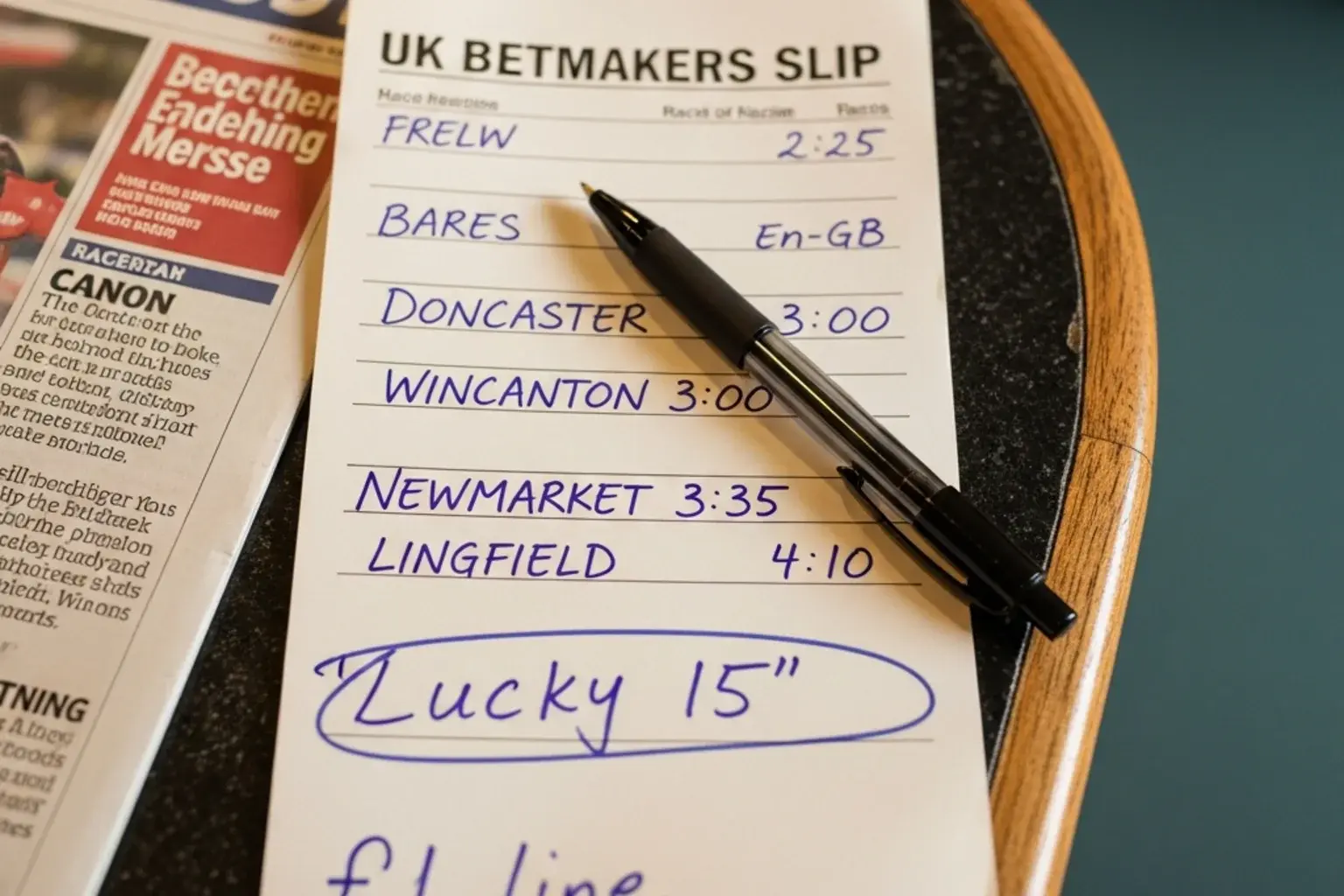
There is a particular sound that only a British betting shop produces, and you hear it most clearly on a Saturday afternoon between half past twelve and the start of the ITV card. It is the sound of biros against the glass counter, the rasp of a slip being folded, and someone reading out four horses to themselves in a low mutter — Doncaster, Wincanton, Newmarket, Lingfield — before going up to ask for a Lucky 15 to a pound. I have stood in that queue for twelve years and I have done that maths in my head a thousand times. The Lucky 15 is the British punt distilled. Fifteen bets on four horses, doubles and trebles and the four-fold rolled in with the singles, and a bonus on top if you get one winner and a bigger bonus if you get them all.
Multiples are a culture, not a strategy. They exist because the British punter has, for at least three generations, preferred a small stake spread across a card to a big stake on one race. The maths is not always kind to that preference. The vig compounds at each fold, and what looks like a 50/1 punt on a five-horse accumulator is actually a series of margin-stacked propositions that the bookmaker is delighted to lay. But the shape of the bet — the way it turns a sleepy Saturday into a four-hour live experience — is unbeatable as recreation, and it is the engine room of casual punter spend in this country.
This piece is a field guide. I have written it the way I would explain a slip to my brother-in-law if he wandered into the shop and could not work out why his Yankee came back paying less than he expected. The maths will be in plain numbers. The bonuses will be where they actually matter. And the bets that British punters love but should sometimes leave alone will be named.
The Anatomy of a Fold
Before we get to Lucky 15s and Goliaths, we need to be clear about the word that everything else in this vocabulary is built on. A fold is one bet. A two-fold is one bet on two selections, both of which have to win. A three-fold is one bet on three selections, all of which have to win. And so on, climbing the scale.
The folds are how you count what is in the multiple bet sitting on top of them. When you ask for a Lucky 15, you are asking for fifteen separate bets: four singles, six two-folds, four three-folds and one four-fold. The fifteen is the number of bets. The four is the number of selections. The terminology takes a little practice because most multiples are named for the number of bets, not the number of selections, with two exceptions that we will get to.
Doubles, Trebles and Accumulators
A double is the smallest multiple — two selections, both must win, returns from the first roll onto the second. A treble is three selections, all must win. An accumulator is the catch-all word for any multiple of four selections or more, although in retail parlance “accumulator” often means specifically a single bet on all your selections rolled into one, without the doubles and trebles in between.
This is where the slip language matters. If you write four horses on a slip and stake £5 to win, the operator will not assume what bet you want. You have to specify: a single £5 four-fold (one bet, £5 stake, all four must win), or a £5 Lucky 15 (fifteen bets, £75 total stake, partial returns on one winner upwards), or any of half a dozen permutations in between. The slip is unforgiving and the cashier will read what you wrote.
The returns on a four-fold compound. Stake £5 on four horses at evens, 2/1, 3/1 and 9/2: your £5 becomes £10 on the first, £30 on the second (£10 x 3), £120 on the third (£30 x 4), and £660 on the fourth (£120 x 5.5). The bookmaker took your £5 once. The fourth horse paid you £660. That is the geometric magic of a fold and the reason punters love them.
Fold vs Line
The word “line” is the punter’s way of describing the per-bet stake within a multiple. A “£1 line” on a Lucky 15 means £1 on each of the fifteen bets, for a total stake of £15. A “50p line” on a Goliath of eight horses means 50p on each of the 247 bets, for a total stake of £123.50. Cashiers and apps speak the same language: tell them the line stake, and the system multiplies up the total.
This is where the maths gets dangerous. A 50p line on a Heinz is £28.50 — easy, no surprises. A £1 line on a Goliath is £247 — at which point the slip is no longer a recreational object and the bookmaker is, frankly, taking your house deposit. I have seen perfectly sensible punters tick “£1 line” on a Goliath without realising the stake. Apps now warn for stakes over a threshold, but the warning is often a single tap to dismiss. The line stake is the lever you should be touching most carefully on any full-cover bet.
Win vs Each-Way Multiples
Every multiple comes in two flavours. A win multiple settles on the win component only — your selections must finish first. An each-way multiple is structurally two parallel multiples: one win multiple and one place multiple, with stake doubled. A £5 each-way Yankee is not £5 across eleven bets. It is £10 across twenty-two — eleven win bets and eleven place bets, each running on their own returns.
The each-way variant changes the calculus completely. We will get to the specifics in the each-way section further down, but the headline is this: each-way multiples are a different bet, mathematically and emotionally, from their win-only siblings. Punters who do not internalise this end up confused when their slip costs twice what they expected.
Lucky 15 and Its Family
If I had to nominate the single bet that defines British recreational betting on horse racing, it would be the Lucky 15. It is a four-selection full-cover bet with singles included. It carries operator bonuses that reward a single winner generously and reward all four winners spectacularly. And it is the bet that, more than any other, structures a casual punter’s relationship with the ITV Saturday card.
Look at the Grand National figures and the case writes itself: roughly half of the National’s bookmaker turnover comes from stakes of £5 or less, which is the heartland Lucky 15 demographic. The same shape holds across the year. Small stakes spread across multiple selections, with the bonuses doing the emotional work of justifying the risk. That is the Lucky 15, and its bigger cousins are scaled versions of the same logic.
Lucky 15 Mechanics
Four selections. Fifteen bets. Stake £1 per line and you are putting £15 on the slip. The breakdown: four singles (one £1 single on each horse), six doubles (each pair across the four selections), four trebles (each combination of three out of four), and one four-fold (all four).
One winner pays out one single. Two winners pay one double, plus the two relevant singles. Three winners pay one treble, three doubles and three singles. All four winners pay the four-fold, all four trebles, all six doubles and all four singles — fifteen winning bets stacking on top of each other, which is where the four-winner payout becomes a number that gets shown to friends.
Let me walk through a single-winner example, because that is where the bonus does its job. Stake £1 line on four horses, three lose, one wins at 5/1. Without any bonus you would collect £6 — the £1 stake plus £5 profit on the single, with the other fourteen bets going down. With the standard single-winner bonus of triple odds (3x the price on a sole winner), that 5/1 becomes effectively 15/1 for the purpose of the single, returning £16. Same selection, same race, same bookmaker — the bonus is the whole story.
Lucky 31 and Lucky 63
Scale the four selections up to five and you get the Lucky 31. Five singles, ten doubles, ten trebles, five four-folds and one five-fold — thirty-one bets in total. A £1 line costs £31. The single-winner bonus pattern carries over and most major operators apply the same triple-odds-on-sole-winner promise to Lucky 31s as they do to Lucky 15s, though the all-winners bonus percentage is sometimes slightly different.
Add a sixth selection and you have the Lucky 63: six singles, fifteen doubles, twenty trebles, fifteen four-folds, six five-folds and one six-fold. Sixty-three bets, £63 at a £1 line. The Lucky 63 is the territory of the more committed punter — the ITV7 finder, the Saturday-card specialist. Statistically you need a strong opinion on at least three of the six to make the slip worth its margin. Realistically, that opinion is rarely there on six races.
Bonus Structures in 2026
The bonus structures have moved around in the past two years, and not always upwards. The market-standard offer on a Lucky 15 as of 2026 looks roughly like this at most major operators: triple odds on a single winner, and a 10 to 20 per cent bonus on all four winners. On a Lucky 31, the sole-winner bonus is sometimes lifted to four times the odds, with 25 per cent on all five winners as the headline number. On a Lucky 63, expect five times the odds on a sole winner at the more generous firms, and 25 per cent on all six.
The thing to watch is which selections qualify for the bonus. Many operators now exclude bonuses if any of the selections is at 4/6 or shorter. That single rule kills a surprising number of slips, because punters writing four-horse slips often anchor with a heavy favourite. Check the bonus terms on your operator’s site before you stake — the page is usually called “Lucky 15 Bonuses” — and treat the headline percentages as the maximum, not the standard.
Yankee, Super Yankee, Heinz and Goliath
The named multiples — Yankee, Super Yankee, Heinz, Super Heinz, Goliath — are the older, more serious cousins of the Lucky family. The single biggest difference is that none of them include singles. They are full-cover bets minus the single-bet layer, which means you need a minimum of two winners for any return at all. That single design choice changes the whole feel of the slip. You are no longer playing for the consolation of one winning horse. You are playing for at least two.
That structural difference is part of why the Cheltenham Festival sees the kind of volumes it does — 68.8 million individual bets were placed across the major operators during the 2025 Festival alone, with the named multiples carrying a disproportionate share of high-stake slips placed on Tuesday and Wednesday handicaps. The Yankee in particular is the festival’s structural bet: four horses across the week, one bet each on doubles, trebles and the four-fold, no fluff. It is the bet of someone who has read the form and has views.
The Yankee at 11 Bets
Four selections. Eleven bets. Six doubles, four trebles, one four-fold. A £1 line costs £11. You need at least two winners to see a return.
The Yankee is the most-recommended bet in British racing punditry for one straightforward reason: it has the cleanest mathematical relationship between stake and payout among the named multiples. The doubles do the heavy lifting on two-winner returns; the trebles compound on three winners; the four-fold pays the kind of number that makes the slip worth keeping. No bonus shenanigans, no single-winner consolation. Eleven bets, four selections, and a payout structure that punters who have done the maths trust.
One important practical note. Two winners on a Yankee usually pay less than you expect. If your four selections were 2/1, 3/1, 4/1 and 5/1 and only the 2/1 and 3/1 obliged, you collect a single £1 double at 2/1 x 3/1 = (3 x 4) – 1 = 11/1 returns. That is £12 back on an £11 stake — a profit of £1. Yankees reward strong opinions on the longer-priced selections in the slip, not on the short-priced anchors.
Super Yankee and the Canadian
Five selections, twenty-six bets — the Super Yankee, also known as the Canadian, is identical in design to the Yankee but scaled up by one selection. Ten doubles, ten trebles, five four-folds and one five-fold. A £1 line costs £26.
The two names mean the same bet. “Super Yankee” is the older British term, “Canadian” the import that took hold in the late 1990s and never went away. Cashiers and apps accept either. The reasoning behind two names for one bet is mostly historical, and not worth your time. The bet itself is a five-selection version of the Yankee with the same merits and the same minimum requirement of two winners.
Heinz and Super Heinz
The Heinz is six selections, named after the famous “57 varieties” because the bet contains exactly 57 individual wagers — fifteen doubles, twenty trebles, fifteen four-folds, six five-folds and one six-fold. At a £1 line, you are staking £57.
The Super Heinz is seven selections, 120 bets: twenty-one doubles, thirty-five trebles, thirty-five four-folds, twenty-one five-folds, seven six-folds and one seven-fold. £120 at a £1 line, and the bet starts to require a level of conviction across seven races that almost no punter genuinely has.
Both bets share the same defining problem with longer multiples: the doubles and lower folds rarely pay enough to cover the cost of the slip on two-winner outcomes, and three-winner returns from a Heinz or Super Heinz are usually somewhere between break-even and small profit. The bet only really sings on four winners or more, by which point the slip needs to have got a lot of things right on a Saturday. Heinz slips are best reserved for cards where you genuinely believe in five or six of your selections — not for filling out a slip because seven races looked vaguely interesting.
The Goliath at 247 Bets
Eight selections, 247 bets. Twenty-eight doubles, fifty-six trebles, seventy four-folds, fifty-six five-folds, twenty-eight six-folds, eight seven-folds and one eight-fold. A £1 line is £247. At fifty pence a line, £123.50. The Goliath is the largest of the named multiples that retail bookmakers will write on a slip without flinching, and it is the one most likely to be staked by a punter who has not really thought through what they are doing.
The reason the Goliath is dangerous is not that it is a bad bet in principle. The reason it is dangerous is that the slip looks deceptively cheap at small line stakes — 25p a line is just over £60 — while the maths required to make the slip return better than break-even across the range of plausible outcomes is forbidding. Realistically you need five winners from eight to start producing the kind of returns the slip price implies, and on an eight-race card with handicaps and competitive races, five winners is a once-a-year event for most punters. Goliaths get staked because they feel large. They are large. That is not the same as being good value.
Patent, Trixie and the Bets That Include Singles
Between the Lucky family and the Yankee family sits a smaller group of bets that include singles in the slip — the Patent and the Trixie chief among them. They are quieter cousins of the more famous multiples, and on the right card they are sharper bets than the Lucky 15 because they carry no bonus structure to lull you into thinking the maths is friendlier than it is.
The Patent is three selections, seven bets: three singles, three doubles, one treble. A £1 line is £7. It is the smaller sibling of the Lucky 15, without the bonus and without the four-fold ceiling. The Patent is the bet for someone with strong opinions on three races who wants partial coverage if one or two of them oblige. It is also, in my view, the bet that most British punters should be writing more often than they do. The single-bet protection is real on three-horse cards, and the absence of bonus restrictions means you are not penalised for having a 4/6 anchor.
The Trixie is the Patent minus singles: three selections, four bets — three doubles and one treble. £4 at a £1 line. You need at least two winners for any return, but the slip is half the price of a Yankee and pays the same way on two winners across three horses as a Yankee pays on two winners across four. The Trixie is the Saturday racing equivalent of an espresso: small, intense, no froth.
Then there are the bets that look impressive on paper and are, almost without exception, oversold by operator marketing. The Round Robin is three selections wrapped in five two-fold combinations plus an up-and-down structure totalling ten bets, with conditional re-staking that most punters do not properly understand. The Alphabet is six selections combined as two Patents and a Yankee on the outer four — twenty-six bets and a presentation that exists more for novelty than for genuine strategic merit. None of these are bad bets. None of them are clearly better than a clean Yankee or Trixie on the same selections. If a cashier suggests one because “it pays better on two winners”, read the small print first.
Each-Way Multiples Without the Headache
The most common mistake I see on Saturday morning betting slips is the same one I made myself when I was twenty-three. The punter writes “Lucky 15 each-way” at the bottom of the slip, ticks the £1 line, and assumes the slip will cost £15. The slip costs £30, and the look on the punter’s face when the cashier rings it up tells you everything about how each-way multiples work.
The structural rule is straightforward. Every each-way multiple is two parallel multiples stacked on the same selections — one for the win component, one for the place component — with the stake on each component matching the line stake. A £1 each-way Lucky 15 is £1 on each of fifteen win bets plus £1 on each of fifteen place bets. Thirty bets, £30. A £1 each-way Yankee is £22. A £1 each-way Heinz is £114. The slips are not deceptive. They are just doubled.
What you get for that doubled stake is a separate place-component multiple settling on the place-fraction odds for the relevant races. For most flat handicaps with 8 or more runners, the place fraction is 1/5 and the bookmaker pays out on three places (first, second, third). For 16-runner-plus handicaps the place fraction is 1/4 and four places pay out. For non-handicap races with 5-7 runners, two places at 1/4 odds. The place fraction matters because the place component of your multiple settles at that fraction, not at the win price.
Walked through with numbers: a £1 each-way Yankee on four horses, one wins at 10/1, two place at 6/1 and 4/1 (each-way places, neither winning), one finishes nowhere. The win component pays nothing (you need two winners for a Yankee). The place component pays one place double — 6/1 at 1/5 equals 6/5, paired with 4/1 at 1/5 equals 4/5 — for a returns calculation of (1 + 6/5) x (1 + 4/5) on a £1 stake. £1 x 2.2 x 1.8 = £3.96. The slip cost you £22 and it returned £3.96. The win component went down, but the place component salvaged something.
Each-way multiples are at their best on cards where the field sizes give you genuine four-place coverage and the prices on your selections are 5/1 and longer. On short-priced selections with three-place coverage, the place fraction crushes the returns. As a rule I rarely write an each-way multiple if any of my selections is under 4/1, because the place component will not earn its half of the stake.
Where Multiples Pay Off and Where They Bleed
I have spent two thousand words explaining how these bets work. Now I am going to spend the next four hundred explaining when they are worth the slip and when they are quietly hostile to your bankroll.
Multiples earn their margin through compounded vig. Every bookmaker prices a race with a built-in overround — the implied probabilities of all runners summing to a number slightly over 100 per cent. On a typical UK Class 4 handicap, the overround sits around 115 per cent, meaning the bookmaker is taking roughly fifteen pence in the pound out of the win market. Roll two such races into a double and the effective edge is not 15 per cent. It is roughly 32 per cent. A four-fold accumulates that to over 70 per cent. The longer the fold, the more savage the structural disadvantage.
That is the case against multiples on cold mathematical grounds. The case for them, which I find equally honest, is that recreational punting is not a returns-optimisation problem. The Grand National brings in roughly £200 million of bookmaker turnover in a single afternoon, and around 30 per cent of those punters either deposited for the first time that year or were returning lapsed customers. The Aintree Festival as a whole pushes that figure to about £250 million across three days. These are not slips written by yield-chasing professionals. Greg Ferris of Entain has put the case for what these events are with admirable clarity: The Grand National and the Super Bowl are cultural phenomena that transcend sports and are annual traditions for recreational customers
. That word — recreational — is the one that matters. The slip is not the optimal expression of an opinion on a race. It is the punter’s experience of the race.
Where multiples genuinely pay off, in my view, is on ITV Saturday cards where you have a strong handicap angle on three of the seven televised races. A Yankee or a Patent on those three or four selections, written for a stake you would happily eat if it goes down, gives you a four-hour Saturday afternoon with skin in the game on every featured race and a payout structure that rewards an actually good day. That is the rhythm the British retail multiples market was built around, and on the right day it is a fine bet. If you want to understand how that ITV card is constructed and which races usually carry the multiples weight, I have written separately on how the ITV Saturday racing card is built for the punter at home.
Where multiples bleed is on midweek cards staked out of habit, on full-cover Goliaths written when you have an opinion on three races at best, and on Lucky 15s where the bonus terms exclude a heavy-favourite anchor and you have not read the small print. The bet does not become better because you have heard of it. The slip is the same maths whichever name is at the top.